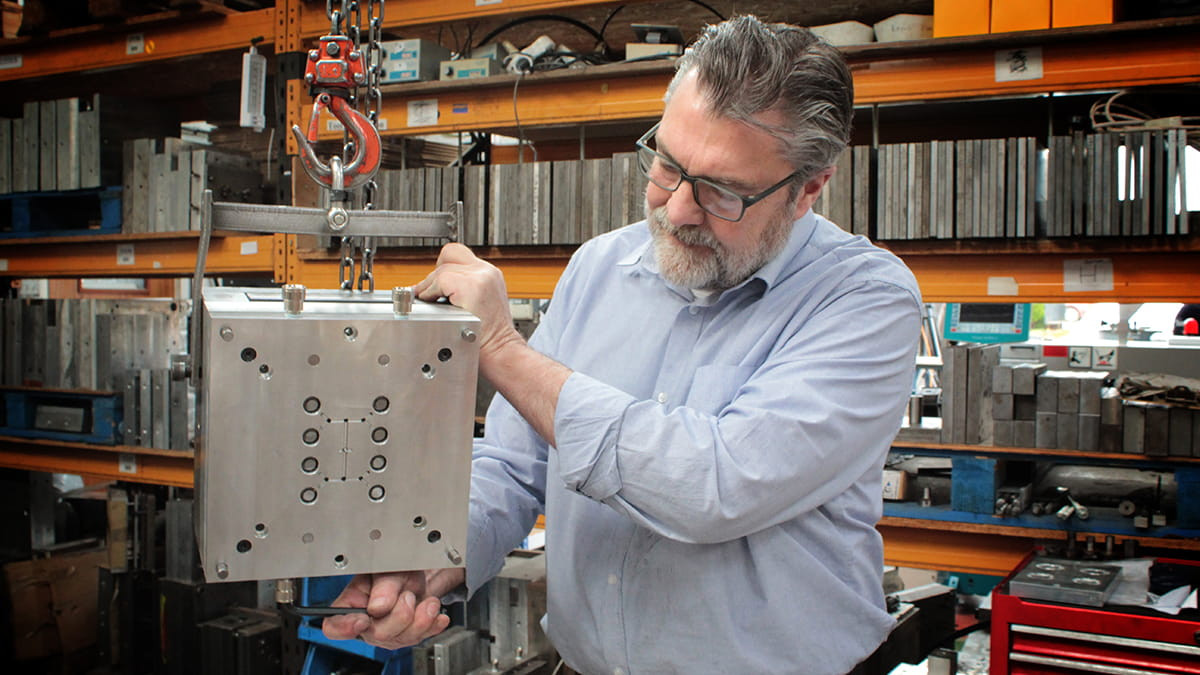

MADE EP.5 | Paul Nicholson on Going From Apprentice Toolmaker to CEO of a £250 million Company
In this episode, we hear from Paul Nicholson on his journey to CEO of the largest injection moulding company in the UK.
Episode Transcript
Prefer to read instead? The full transcript is available below.
Kiron: Welcome to another episode of Made, the podcast that talks to those that have made it in industries that make things. Today I'm joined by Paul Nicholson, CEO of WHS Group, and we're gonna have a little chat about your story, which I particularly find very interesting. So thank you for joining us, Paul.
Paul: You're welcome.
Kiron: I know obviously we met a couple of years ago, and you were very open with me about your story and I have to say, you spent a lot of time with me personally and our business, which I'm very grateful for, to kinda take me under your wing for the best part of 12 months with advice. Which I know is something you're really passionate about for the next generation. You yourself obviously didn't start as CEO. So do you mind just sharing with us where, where you started and how you got into where you are now?
Paul: Yeah, certainly. I mean you're right, I didn't start as a CEO, and I don't know if I ever intended to be a CEO, but I started off as a toolmaking apprentice.And that was not in the plastic injection molding but in the stamping world. But it's very similar background. I very quickly realized I was never gonna be the best toolmaker in the world.
Kiron: How did you get into that to begin with? What, where did that passion come from?
Paul: That was I actually wanted to join the Navy. And I tried twice to join the Navy as an artificer, which is an apprenticeship in the Navy, and failed twice the entrance exam. You know, I'm not a very academic person, as you can probably tell from that. So I wanted to leave school. I didn't wanna carry on at school at 16 years old. My parents were very clear, "If you're gonna leave school, you have to get a job." In those days, apprentices were quite, quite a lot of them around, and there was one that came up, so I took it and started. I had no intentions of being a toolmaker, no intentions of going into engineering. It was just the first job that came along that offered me. And it was better than going back to school. So it was in the school holidays when I was 16 years old, got offered the job, so I took it. Never really took to it, to be honest. I was never gonna be a good toolmaker. II got through my apprenticeship, got offered a job on that. Decided it's not really what I wanted to do.
Kiron: What was it about the toolmaking that you found wasn't a fit for you?
Paul: Toolmaking in its sort of nth degree is quite an intricate world, and you really need an attention to detail, and I was a little bit impatient, I think. You know, I wanted to see the results quicker. And I just don't think I had the skills.
Kiron: Okay. So then you, you kind of made, made peace with that probably wasn't where you were gonna go career-wise. Where did you then go into after that?
Paul: So I carried on being a toolmaker. Toolmaker machinist. Took different jobs. But I knew I liked to travel. That was a big thing for me, so I'd really enjoyed traveling. A friend of mine at the time moved down to Bournemouth. I was living in Milton Keynes, where I grew up, and he said, "Oh, it's great in Bournemouth. Come down for a weekend." So I went down for a weekend. Enjoyed it. He was on a building site down there on a year-long contract. So in those days, you could pick your toolbox up, and you could get a job anywhere really, as long as you were qualified, which I was. Wasn't the best, but I was qualified. So I went down to Bournemouth, worked down in Bournemouth. Realized very quickly, as a young man, single man, I was killing myself drinking all the time. So I took a job on night shift and literally became a night shift, milling machine operator.
Kiron: Right.
Paul: It was fantastic. It was four 10-hour shifts. So you started work Monday night, finished on Friday morning, and you had a very long weekend to enjoy yourself. So as a single guy in Bournemouth, that was just a fantastic life.Went back to Milton Keynes for a weekend, I was 22 years old, and met my wife, or my now wife, I should say. Sorry. Very quickly we realized we didn't wanna live in different places. She was from Gloucestershire. So Ileft Bournemouth, moved to Gloucestershire, and within a year we got married.
Kiron: Wow. Blimey. So you got married at what age?
Paul: 23.
Kiron: 23.
Paul: Literally, I got married in the August. I was 23 in July.
Kiron: Oh, wow, blimey. So you get married. You've obviously... You met your wife. You're kinda thinking about location, and all that, so then, then where do you end up?
Paul: So then we decided it's... This just seems a bit serious getting married. We suddenly realized we'd met and married within a year and didn't really know each other, so we thought we'd do some traveling. So we went off to Spain for six months, worked in Palma, Mallorca in the Strawberry Pig. That was the name of the pub.
Kiron: How was that?
Paul: That was a load of English people coming in. The best anecdote I can give you on that one was the guys had come in from England, all got football shirts on, typical sort of people coming into Palma in those days. And, we had all of the bar pumps, you know, with Stella, with Heineken, all the different ones you could think of at the time, the lagers. And people would come in and say, "I only drink Stella. That's the best beer in the world." Every single pipe went into the same cheap Spanish keg underneath the bar. And they'd all pick their pint up and say, "That's just like home. That's fantastic." And we were selling it at a premium price and paying next to nothing for Spanish lager, so. Brilliant. So we did that for six months, and then we went to Australia.
Kiron: So what prompted that move?
Paul: Australia? Yeah. We just wanted to keep traveling, and we really fancied it. They were... At the time they were doing one-year working visas.
Kiron: Right. Okay.
Paul: So we moved over to Australia, spent six months in Melbourne. My wife was a hairdresser at the time, so she was just hairdressing in youth hostels, you know, in the evenings to make a bit of money. I got a job, again, as a toolmaker, so I spent six months toolmaking in Melbourne.Then we spent six months traveling around Australia and really enjoyed that time traveling. And those were the days where you could do things like climb Ayers Rock, which you can't do now. We did a diving course on the Barrier Reef, so we were swimming with dolphins. There were a lot of things you're supposed to do before you're 50. I was doing them at 20, you know? And we had a fantastic time, but then we came back. So I was probably 25 when we came back from Australia, and we said, "Right, now we know we have to sort of settle down a little bit." And realized I didn't wanna go back into toolmaking. So I took a job as, I think it was called a commercial engineer, I think was the actual title. Very low pay could have earned a lot more money toolmaking, but I wanted to get into the office environment. So I went into that environment, and it was literally people were asking for spare parts for machines like you see around us now. My job was to get the drawing out, identify the spare part, get some quotations for it, do a quotation, and sell the spare part to them. So that was my introduction into the commercial aspect of, of business I would say.
Kiron: Okay. And then how long was that role for then?
Paul: That role was a strange role because, realized again I was stuck in one place, and I had the wanderlust at the time. I'd, you know, been in Australia for a while. So they, not only did they sell spare parts, they fixed machines as well.
Kiron: Right.
Paul: So I got into that side of it, which is a sort of still engineering role, but you'd go off somewhere, fix a machine that's broken down, and then come back. So I did that for quite some years.
Kiron: Still within the same role or did you progress through that company?
Paul: Well, started off as a service engineer, went into project management. Right. So I ended up then running the sites.
Kiron: Yeah.
Paul: And went all over the world doing that. You know, I was literally India, China, South Africa, all the different countries, and I was literally just repairing machines all around the world.
Kiron: So that kind of scratched your travel itch a little bit.
Paul: Yeah. Absolutely.
Kiron: And then I assume you leave that role at some point. What was the reason for the next move?
Paul: Well, it was interesting. I was working for an English company, but it was American owned, owned by an American entrepreneur who was always in trouble financially. So I thought, "This is not the right place to be." And I was fixing a machine at GKN in Telford.
Kiron: Mm-hmm.
Paul: I got talking to the boss there, the manager there, and he said, "Oh, we've got some German machines. And the German machines we can't get serviced, we can't get help." He said, "You should go and work for them." You know? And it was a company called Muller Weingarten at the time. So I literally wrote to them speculatively and said, "Any work in the UK?" They wrote back and said, "Come to Germany. Come and meet us." So I flew over to Germany, met them, and at the time we had no children. You know, we were a little bit, I suppose, crazy and making silly decisions, and they offered me a job. So I went back, handed me notice in, you know, one month's notice in those days, and after three weeks I got a call from Germany saying, "Um, actually, we can't employ you. We have nothing in the UK." "We don't know how to employ you in the UK." "We can't employ you in Germany." So I thought, "Well, what am I gonna do now?". Yeah. I've got no idea what to do next. They had an agent selling, selling machines, you know, so an independent company, just an agent for their machines. So I contacted them, and they said, "Yeah, we'll employ you. Yeah. We'll get the money from Germany. We'll pay you, take tax and national insurance off."
Kiron: So they're UK based?
Paul: They are UK based. In Banbury. So I started working for them as a sort of a service manager for the German company for the UK market.
Kiron: Yeah.
Paul: Well, very quickly I realized this is ridiculous. This guy's making a load of money on the back of the Germans, and they don't really realize what's happening.
Kiron: Mm.
Paul: So I suggested to the Germans that they start a UK subsidiary, Muller Weingarten UK. So I went to Germany, pitched the idea to them, and they said, "Good idea. Start it." You know? So I said, "Okay." And Germans being very organized said, "We know how to start a company." So they got the German Chamber of Commerce involved. We went down to London, you know, went into one room. We had the bank come in first, then the insurance company, then the people printing business cards, and I walked out eight hours later as the managing director of Muller Weingarten UK.
Kiron: Ah, blimey. It's quickly becoming apparent that you're very entrepreneurial. Is that something that you think was innate, or is that something that you learnt? Is there a particular... Where did that come from?
Paul: I think that's really interesting. My father had his own business for many years. My mother and my father were split up, so it wasn't really an influence on me. But my father always had his own businesses, so-
Kiron: Right
Paul: in vending, in sort of coffee, tea vending, so nothing to do with what I did. But it's a really interesting question about entrepreneurship because I've always worked for a company. I've never owned a company.
Kiron: Mm.
Paul: You know? Um, but there is a term in Germany, which doesn't really exist in England, called intrapreneurship. You know, which is where you're entrepreneurial within an organization.
Kiron: Mm.
Paul: You know? So I've always classed myself as an intrapreneur rather than entrepreneur, if that makes sense.
Kiron: Yeah, yeah. That makes sense, yeah.
Paul: So that's a really interesting word that sort of doesn't really translate, but the meaning does translate, I believe.
Kiron: Yeah. Oh, it makes perfect sense. So what age are you at this point when you're now MD of this-
Paul: 29.
Kiron: Right, so 29 ... your first MD role, basically.
Paul: And I've never had another title. I'm 62 now. I've never had another title except managing director or president or CEO, since I was 29.
Kiron: It's a similar type of role, just a different name.
Paul: Yeah. But I mean, I was MD on paper. My business card said MD, but I went back to work the next day fixing machines so I wasn't really an MD.
Kiron: Yeah, yeah. Okay. And then how long did that role take?
Paul: Well, again, that was another one where I think I was… If I'd known what I know now, I wouldn't have done some of the things I'd done because I... It was crazy. You know? So this carried on. The company that I left, the Texan guy that owned it, shrunk it down from a manufacturing company to a pure sales and service company. And there was about 35 people in that company. I was still one person working from my home. So I went back to Germany, said, "I've got a really good idea. Why don't we buy the company I used to work for?" You know? And they said at the time, "You can do that." "How much do you need for it?" And I'm going back to, oh- '99 maybe, something like that.
Kiron: Right.
Paul: And it was about a million pounds, round numbers. And they said, "You have to raise half the money yourself in the UK." This is all new to me. This is learning by doing.
Kiron: Yeah, yeah.
Paul: You know? So I literally went to the bank, 'cause we had a little company in England. We were turning over at the time probably 7, £800,000.
Kiron: Blimey.
Paul: Yeah, just doing selling service work really, you know, using subcontractors. Barclays Bank decided to back us. In those days, the bank manager backed people. You know, it was much less computer says no type of territory.
Kiron: So was that a relationship you had with said manager or was that still very much like business plan, here's all, all-
Paul: It was really I went to see him. I didn't know what a business plan was at that time. You know, I literally went to see him. I said, "This is what the plan was. Germany will put in half a million, if we can raise half a million?" So he sort of supported us on that journey. And we went back and bought the company I used to work for, which is interesting 'cause I'm now MD of a 35-people company.
Kiron: Mm.
Paul: Yeah, and still not really know what I'm doing. So the learning was incredible.
Kiron: Do you think there's a lot to be said about kind of learning as you go? 'Cause obviously you make more mistakes, but you learn from those mistakes.
Paul: Yeah, I mean, I was very fortunate because after that, you know, the American company that owned us, the American guy that owned us, had a company in America as well, so my next suggestion was, "Let's go and buy that company." You know? So we went and bought the parent company of the one I'd bought. So we bought that in 2006.
Kiron: Right.
Paul: At which time my daughter was five, I think. Five or six at that point. No, she's ... Sorry, she was 12, 13 at that point. She was born in '93. So I couldn't move to America at that point, but I needed to go and integrate that company. So I moved there for 12 months but came home every five or six weeks. Very difficult time, I think to do that with a young-un. Very difficult for my wife as well. But we did that, and it was a fantastic time professionally but, you know, very difficult personally to deal with that.
Kiron: Did your family ever move out to-
Paul: Nope. They came on holidays, but they never moved out there with me.
Kiron: How long were you in America for?
Paul: It was about 12 months. You know? And then on the back of that, the Germans said, "Well, you've done a great job integrating these two companies. Come and work in Germany, at the headquarters." So then, my work relocated to Germany. I relocated back to it, or moved back to England or stayed in England. And I was commuting to Germany every Monday, flying out every Friday, flying back.
Kiron: Oh, wow.
Paul: And I was in Germany for three, four years doing that job.
Kiron: Wow. Well, that must have taken its toll, just fatigue and everything, huh?
Paul: That was I think the most difficult time, because it was, it was hard. So my office was in Germany, but I was responsible for everything the Germans did outside of Germany from an after sales point of view, so sales, service. And, I did that for quite a long time. But if I was not traveling, I was traveling to Germany or I was in India, China, Brazil, Mexico. Literally lived in an airplane.
Kiron: Yeah, yeah.
Paul: I mean, some great stuff on the back of that. You've got every gold card for every airline. So you're treated like a quick king when you travel anywhere.
Kiron: Yeah.
Paul: But my God, it was a, it was a tough time.
Kiron: Yeah. Yeah. I can imagine. Is there a lot that you learn either subconsciously or consciously from the different ways that different cultures conduct business, the way that they run companies that you think is something that you've taken with you to the role that you sit within now?
Paul: Yeah, absolutely. I mean, the very first company when I was a commercial engineer was Japanese-owned. It was owned by Hitachi Zosen, so that was Japanese. Spent a lot of time in America, and predominantly worked for Germans. And I think if you could blend those three cultures, you would have the perfect world. I mean, the maverick attitude, the gambling attitude of the Americans, the management of the Germans, and the work ethic of the Japanese. If you could create those three togethe you'd have almost the perfect scenario.
Kiron: Yeah, I 100% agree ... That'd be, that'd be the dream to, to create.
Paul: That, that's absolutely the dream, you know?
Kiron: So how long were you then ... You said you were in Germany for about four years?
Paul: Yeah, four and a half.
Kiron: So then what, what year are we at when you leave that role?
Paul: Oh, you're asking me now. These years just blend into time now.
Kiron: Well is there a step between that and what happens between that and WHS?
Paul: Yes, absolutely. A couple of steps, actually. So 2010,I was approached by another German company to come and run-
Kiron: Germans like you.
Paul: Yeah. I think I migrate towards Germans. I mean, I've learnt a lot from German management. Which frustrates a lot of my English colleagues cause, you know, even turning up on time for meetings, you know. In Germany, if you're on time, you're late. You know, so really that's sort of that med- That punctuality and meticulous of the German culture is, I think, quite ingrained in me
Kiron: Yeah
Paul: Which is like good and bad, you take that from it. But another German company approached me and said, "Look, we've got an MD's role in the UK, but it's responsible for the UK, Slovakia." I was chairman of India, a couple of other countries. "Will you come and do that job?" And I did that from 2010 to 2015, and I loved the job, but I didn't like the product. They were a service company, and they sold people effectively. You know, so we had two and a half thousand people just at Jaguar Land Rover. Everything from cleaning to maintenance to, you know, all sorts of... Anything the car companies wanted to outsource, we took on. So really it was no product. It was no tangible product, and I've always been involved in making something. You know? So I did that for five years but never really enjoyed it because of the product side of it. Customer base was the same, wasn't much different. But then my former company rang me back up and said, "Look, can you come back?" You know? "And will you come back and run our North American operations for us?" So at that time, my daughter had just started university. My wife and I had been married for quite some time at that point, and we looked at each other and thought, "Well, we've got to talk about something now, so let's go and have an adventure. Let's move to America." My wife at that time was a police officer. She'd moved from hairdressing to, she had her own career, and she was a detective in the police force.
Kiron: Oh, okay.
Paul: So she got a career break from the police, which turned out to be a disaster because they offered her a five-year career break, but after one year cancelled it.
Kiron: Wow.
Paul: So she then had to make a decision to leave the police force, which was, I think, a very difficult time for both of us because she didn't really want to leave it. She thought she had the best job in the world at the time.
Kiron: Why was that, you know?
Paul: Because in the police, if you were... even if you were on a career break, you were still on the head count.
Kiron: Right.
Paul: And they were running short of detectives, and they couldn't replace her because she was still technical on the books. It was a sort of typical government type, you know, civil servant type problem. It wasn't a real problem, but they weren't paying her. But she had to take that decision to leave. So that was very difficult for her at the time, for us at the time. So we moved out to Detroit in 2015, and we had a whale of a time. I was running the operations in Canada, the operations in Detroit, and the operations in Mexico, and I sat on the board of the operation in Brazil. So that was a great opportunity. And if you're a car guy, and I've always been a car guy, to go and work in Detroit, in the sort of the center of, I call it the center of automotive, was just an opportunity that couldn't be missed. It was just amazing, you know? And you'd suddenly have meetings in Ford World Headquarters or, you know, or GM's World Headquarters, and you're just seeing a different world to it.
Kiron: Yeah.
Paul: And it's different numbers. You know, if we make a million cars in England, we're in great shape. They're making 20 million cars a year . It's just everything is just on steroids to what we are today over here.
Kiron: Yeah. Yeah. Wow.
Paul: So it was a brilliant five years.
Kiron: So Paul, do you think that there is a future for UK business owners? Because every story that I seem to come across is business owners moving to the likes of Dubai. You've obviously done it kind of almost the other way around, working overseas. What's your thoughts on that?
Paul: I think it's a great question. It's an interesting question as well because I think there's, there's more than one aspect to it. We spent a year in Australia in the late '80s, and there was no FaceTime, there were no emails, so you literally wrote a letter or you booked a phone call home. So that's why we didn't stay in Australia. We wanted to be around family. The same thing happened in America. We knew we were not gonna live there forever, so we made the most of the adventure, and that's fantastic. So there's more than the financial element. So everything we hear about people leaving the country is based around finance. You know? But there's a whole family element to it. There's a whole people element to it. So I think there will always be an element where people are more interested in money than they are in family and culture and everything else. But I think it's very small. You know? And, and when you talk about Dubai as an example, there's that many people that aren't rich, influencers, real estate agents moving over to Dubai because they wanna leave England, they want something different, whether it's weather, whether it's culture. So I think if you only look at the finances, yes, there's lots of reasons not to stay in England. I mean, tax rates are punitive. I was paying significantly less tax when I was living in America. And, and a lot more of your income stays with you. So I think if you just look at the money, people are always gonna leave at some point, but I think it's gonna be very few and far between. And you've really got to reach, we talk about the top 1%, but you've got to be in the top .1% to be able to move abroad. You know? Because most of us are, our jobs are here, our work's here. You know, our businesses are here, and just to relocate is not that easy. So there's only a few people that can move.
Kiron: And- I guess there's more to it. I mean you touched upon it earlier about all the, the good qualities of some of these countries, like you said about the Japanese work ethic et cetera. But there's a lot of cultural shift in understanding to embed into a new culture, aside from the financials. You've got to adapt and adopt their culture to be able to succeed in an industry that you choose to choose.
Paul: Yeah. And it's a mindset thing as well. I mean, I remember going to America, and there's 330 million people in America, and I tried opening a bank account. And it's the most difficult thing in the world. And the first thing you do is say, "The Americans are stupid. They don't know how to do it." And then you suddenly realize, actually, I have to adapt. So if that's what they need to open a bank account, then I need to understand their system. I can't expect them to become English. I am English, so I didn't ever wanna become American. I loved their culture. I loved working in their country. I loved everything they had to offer. I never wanted to become American. And I think if you really want to ingratiate yourself properly into a community, you've got to start thinking like them and behaving like them. And I'm too fundamentally English to do that.
Kiron: Yeah, yeah. So that brought you back to England eventually.
Paul: That brought me back to England.
Kiron: Which brings us on to obviously the WHS part of your story. So how did that conversation even happen? 'Cause I assume you were still in Detroit when this conversation started.
Paul: So back in 2010, I think it was, 2011, Jaguar Land Rover launched the previous Range Rover to what's the version that we have today. And I got invited to the launch. I often get invited to the launches of these things. And it was in Morocco And it was a guy called Ian Harnett, purchasing director at the time-
Kiron: You get invited, sorry, because you're a petrolhead, or is it a career thing?
Paul: Because I'm quite well known in the industry, I guess, really. So I get invited to a lot of these types of things. And we've always been suppliers to JLR, so I got invited to Morocco for the launch, and I drove down to Southampton. They hire a private jet. You get on a jet, you fly out there, and you do the whole press thing for five or four, five days. It's a real jolly. It's lovely. So I walked up the aisle on this plane, and I thought, it's five hours to Morocco. I spend all my time on airplanes. I don't like to sit on my own. Who can I talk to? And as I was walking up the aisle, the first person didn't look very interesting. The second person looked a bit more interesting, so I said, "Can I join you?" And he looked a bit cheesed off, to be honest, 'cause he was reading his magazine. So he said, "Yeah, sure." So I sat down, and that happened to be the owner of WHS.
Kiron: Right.
Paul: So whenever we talk, we say we met on a private jet. That's the story we sort of peddle out to the industry. So we got talking. Five hours later, we were... just clicked, and we were great friends. And, I was living in America at the time, so we kept in touch. He did a lot of work in America. So he'd come over. We'd have dinner every time I was back in England, 'cause we came back to see my daughter regularly. We'd have dinner, and we just kept in touch. And then I said to him one day, "I'm coming back to England anyway now. With five years is up. My wife wants to come back. My daughter's getting married." So lots of reasons that bring us back. And, and honestly, I've been offered this particular job, and he said, "Yeah, it's a good company. I know the company well." And then he rang me a week or so later and said, "I've got a new idea. Come and run WHS."
Kiron: Okay.
Paul: I said, "Well, I know nothing about plastic 'cause I'm a stamping guy. Your son works in the business, so why is your son not gonna run it?" So long story short, I came back, and took over.
Kiron: What was the other role that you were considering?
Paul: It was to run an alloy wheel company actually. You know?
Kiron: Right. Okay.
Paul: Yeah. Similar type thing. Still a supplier to JLR and all the car companies. So really, that's what I do, you know? I'm never gonna run a bakery or a pharmaceutical company. I'm always gonna be in somewhere in that automotive supply chain.
Kiron: Yeah.
Paul: So yeah. So he offered me the job and said come and run my company.
Kiron: And what was it about the conversation or the offer that- Kind of encouraged you to make that switch into plastics?
Paul: I think because it was different. Again, it was one of those decisions where it was a different industry. Still was motor supply, but it was plastic, not metal.But also, I'd been in a corporate world all my life. You know? And I thought, "This is gonna be different. This is working for a guy who lives around the corner, who's gonna be walking in every day." You know?
Kiron: Family run.
Paul: Family run. So it's gonna be completely different. It was a nice size company. It was about a £75 million company. Had probably 400 employees, all based in the UK, so no traveling, which had appeal to me living in America. I traveled less 'cause I lived close to the factory. So I thought this could be an interesting opportunity.
Kiron: And what was his brief to you in what he wanted you to do with the company?
Paul: Again, interesting, 'cause I sat with him on day one, I said, "What do you want from me?" And unlike a corporation that has strategies and plans, he said, "I don't know." He said, "Look, I'm third generation. My grandfather started the company, so we've got a nice company. So whatever you do, make money and don't bet the whole ranch on one deal."
Kiron: Yeah.
Paul: That, that's what we did.
Kiron: And what did you do?
Paul: So, well, I started on the 1st of January 2020, so 10 weeks later it was COVID. So after 10 weeks of looking at the business, I closed it down. Sent everybody home and the government paid their salaries.
Kiron: So not off to the best of starts.
Paul: It was an awful start. So, we came out of COVID, which in hindsight was relatively easy because we sent the people home and the government paid their salaries. But when we came out of COVID, we went into the global semiconductor crisis. Which meant that everyone was making cars, but only a few of them, and that was the most difficult two years of my life. There's no two ways about it.
Kiron: Wow.
Paul: It was such a hard job to do. But in that, the market changed drastically, and we had one big competitor, called Xander Automotive, which was twice as big as we are. So twice as many sites. We had three, they had six. We had, um, I think 700 employees at that time.
Kiron: And were they a direct competitor, just bigger?
Paul: Direct competitor, yeah. All Jaguar Land Rover. We were all Jaguar Land Rover. So we had one common thing. And we quoted, they quoted. We won it or they won it. So we just had basically all the plastic parts for Jaguar Land Rover between the two companies. And they'd made double the losses we'd made 'cause everyone was losing money at that time. So I put a plan together to buy it. Which when I went to him, he said, "What happened to not betting the ranch on one deal? Because that's what you've just done."
Kiron: And that was your first kind of big move really in that role wasn't it?
Paul: That was a huge move. Yeah, I mean would've been there for sort of two years, I suppose, at the time, something like that. We put that one on the table, and we got it over the line, and we ended up buying that company, which meant overnight we tripled in size.
Kiron: Yeah,
Paul: Which is a massive difference.
Kiron: Yeah. Did you get much pushback from the family? Or were they on board relatively quickly?
Paul: Well, Clint, who is chairman and 100% shareholder of the company, him and I had a relationship where… I remember we were about to sign the deal. It was a Friday night. These deals always go to Friday nights. You know, lawyers are still arguing. And, I sat in the office and I said, "Look, this isn't gonna happen in the next couple of hours. I live an hour from the office." So I rang him and said, "I'm gonna go home. I'm gonna open a bottle of wine. I'm gonna pour it out, but I'm not gonna drink it until we get this deal signed." And the lawyers were still arguing. So I drove home- Poured the wine at 5:00, and it was 10:00 when we finally signed the deal. And I got the phone call from the lawyers to say, "Well, we're ready to sign." It's all DocuSign nowadays, so you don't have to actually physically be there. And he rang me and said, "Before you press that button," he said, "you better be up for this." He said, "'Cause I'm not certain I want it, but if you want it, I support you." So that's the relationship we had. So we did the deal. We bought it.
Kiron: That's awesome that he backed you so much on that.
Paul: And he backed me 100%.
Kiron: Yeah, yeah.
Paul: And it's just a great relationship.
Kiron: Yeah. Well, it proved to obviously be the right decision 'cause you've gone from strength to strength. Granted, it's not been linear, but it proved to be the right decision. Is there anything I wanted to just touch upon? You mentioned, Clint is 100% shareholder.
Paul: He is, but unfortunately he passed away two weeks ago.
Kiron: Oh, blimey. Sorry to hear that ...
Paul: 72, got seriously ill and he passed away two weeks ago.
Kiron: Okay. So that kind of changes the direction.
Paul: But the family are still 100% shareholders.
Kiron: Okay, fine. what's your mindset? You mentioned the difference between intrapreneurship and entrepreneurship, and many people you speak to that wanna grow companies, et cetera, that shareholding or of owning an asset essentially is quite important to them. For you, it doesn't sound like that is, or am I wrong? What's your thoughts on owning part of WHS in your mind?
Paul: Yeah, I mean, it's always been one of those things where you think, I could have done, I should have done. I think I've got to the stage now where I've been very fortunate, I've been backed very well. I've done quite well financially through my careers. I've never owned a company, and I'm at the point now where I probably won't. But I've always done very well out of it. You know? It's that ultimate risk and reward, isn't it?
Kiron: Yeah. Yeah, yeah, for sure. And then you mentioned the sad news of Clint passing. I mean, that must have also had a major impact on you and the family 'cause the family-owned business. How's that been? 'Cause he was your chairman. Was he still, right up until his passing, quite involved? Was he there on site? Did he come to stuff?
Paul: In the six years I've been there, it's quite interesting because, I said I knew it was gonna be different. But I hadn't had a boss in the same country for 25 years. So again, we talk about running your own company. I had effectively run my own company, I just didn't own it.
Kiron: Yeah.
Paul: You know, but I didn't have bosses. So bosses always, you know\... You knew the boss was coming, you cleared your diary for a week, you painted all the grass green and sorted everything out. You sold confidence basically for a week. They went off to run their whole global group, which is what I was in.
Kiron: Yeah.
Paul: Suddenly I was there, and I was in a board meeting, and Clint just turned up at the window, tapping on the door, and you think, "Well, what the hell do I do with this?" So we had to reset the rules there and say, "Clint, you can't just, you know, it's not my way of working. If you wanna come, make an appointment, tell me you're coming." So that was new for him.
Kiron: Yeah.
Paul: But we got into that routine, and he really was, you know, he tended to be a very key person for me. Every decision, it was his money. I went through him on big major decisions, but I run the company 100%, and I still do that today.
Kiron: And was that, was that a case of as conversations needed to be had, they had, or did you have a schedule where it was like once a month we'll have a check-in?
Paul: We didn't... It was very informal. And having said that, he's a big car guy himself. Had a workshop where he did a lot of work on cars, and we held most of our board meetings in his garage while he was working on a car. I'd make the coffee, we'd sit and chat. And we bought Xandor in his garage, I always say that. You know, I don't think we had one minuted meeting when we bought Xandor, and that was a mega deal really. But it was done on that sort of mutual trust basis.
Kiron: Yeah. Oh, that's amazing. So then obviously the company has gone from strength to strength. After Xandor and the progression you've gone to, what was the next big step?
Paul: Next big step for us, the market in the UK continued to consolidate. There's too much capacity in the market. There was a large Austrian company called Polytec, who decided to exit the UK last year. We got approached to look at that by our main customer. So we looked at it, and on the 1st of January this year, we actually completed that acquisition. Which is another 500 people, another 50 million in sales.
Kiron: Yeah. Congratulations.
Paul: So it's made us very, very big now, and I think in the UK molding market, we are without a doubt the biggest company in the market now.
Kiron: Yeah. So, how big's the team now?
Paul: 2,500.
Kiron: Yeah. And turnover?
Paul: Turnover's about 250 million.
Kiron: Blimey. So from where you started to now is a completely different animal. We also haven't mentioned yet, but you guys have got a site in Egypt, right?
Paul: Correct.
Kiron: How did that come about would be my first question, 'cause that's quite unusual to have this UK family site, obviously you got multiple sites, and then Egypt's just there. Where did that come from?
Paul: That's really interesting. That was started in 2007. I said about intrapreneurs and entrepreneurs. The guy, Clint, who owned the company, is the most entrepreneurial person I've ever met in my life. As well as owning WHS, he owns garden centers, he owns restaurants and building companies. He just has that ability to start a business and make it successful. And we did a lot of work for a company called Leoni, which is a large German wiring harness company, big supplier into Jaguar Land Rover. And they came to us and said, "Look, you make all the parts for us in England, you ship them to Egypt where our main plant is." "Then we assemble them into a wiring harness, then we ship them back to Solihull. It doesn't make any sense, so we're gonna have to remove the business from you." So Clint immediately looked at that and said, "Unless I start a business in Egypt." So we literally started a business next door to theirs, like a hole in the wall operation, and we supply into Leoni.
Kiron: Blimey. And what's that, what's that like on a kind of day-to-day, 'cause obviously the distance and how does that work?
Paul: Well, we quickly realized that again, culturally, you know, the first thing that happened was a house was bought next to there and we started sending out English management to the company and realized you can't do that. It doesn't work. So we now have an Egyptian MD, an Egyptian FD, and they run it, and I go out there four times a year for a board meeting more strategically to look at it. They run it 100% themselves.
Kiron: So apart from your kind of once a quarter meetings essentially, are they kind of left to run things?
Paul: Completely left on their own. They run it the way I used to run subsidiary companies when I ran for the Germans, yeah? It's their company, it's their money in their mind. And they run it as that, you know? And it's a proper family company out there with them as the head of it.
Kiron: Yeah, yeah.
Paul: It's, it's a great little operation. 220 people, so not small.
Kiron: Yeah, yeah. Blimey. So how many sites now globally including that?
Paul: We have 10 in UK and, and Egypt. 11.
Kiron: So 11 sites.
Paul: Yeah.
Kiron: Clearly the business is in the right hands. You've been there, you've got the support of the family.
Paul: Thank you ...
Kiron: And we wish you all the best for the future.
Paul: Thank you.
Kiron: Look forward to seeing what happens next.
Paul: So do we.
Kiron: The future of molding and the industry and all the rest of it outside of WHS is an interesting one. There's a lot of changes. Things are developing rapidly. Things like AI and autonomous driving we've been talking about on previous episodes and stuff like that. How do you feel about it? Do you feel optimistic about plastics molding, manufacturing as a whole? Is this stuff that we should probably be a bit concerned about? What's your thoughts?
Paul: I've been in the industry a long time now, automotive particularly, but manufacturing, especially, and it's, the only constant is change, is what I was taught from the very beginning, yeah? And we can focus on the change and look at the threats to that, or we can focus on the change and look at the opportunities that spring from it. So the market consolidated, then the opportunity to buy Xandor. Polytech decided to pull out, opportunity to buy that. So I'm overly optimistic. I think if you're in the automotive industry, you have to be optimistic. But I think it will continue to evolve, it will continue to change. AI is a great example. Yeah. We can look at it as a threat or we can look at it as an opportunity, and I look at everything as an opportunity, and how do we evolve? Because there's revolutions every now and again, but there's evolution is constant. Yeah. So I think constant evolution is what will keep us ahead. And there's gonna be constant challenges. There's the China challenge, we've been through that, but I can remember in my career, 2007, '08 crisis, financial crisis, the world ended. Very difficult time to manage through. But a lot of opportunities came from that. And I just believe every change, every evolution will bring opportunity.
Kiron: Yeah.
Paul: Be it electric vehicles or anything else that's thrown at us.
Kiron: Well, I mean, it's refreshing to hear, but yeah, I agree with you. If we're optimistic about the opportunities surrounding it then can only go in one direction really, can't it?
Paul: The biggest problem you can, you can make for yourself is to not evolve.
Kiron: Yeah.
Paul: Somebody once called me a dinosaur, and my daughter said, "You're not a dinosaur, you're a crocodile." And I said, "What's that?" She said, "It's just a dinosaur that evolved."
Kiron: That is a good analogy,
Paul: Which I thought was great. And, and that's really what it is. You just need to constantly evolve. The world will change around you. And if you say, "I'm only ever gonna make DVDs," you'll be out of business. Or, "I'm only ever gonna make, you know, videotapes," you're gonna be out of business. But if you evolve, you can, you can evolve and keep business going, and I think we are, as a UK, a good manufacturing nation.
Kiron: Yeah, yeah.
Paul: You know, we've got good skills, you know, we've got a good manufacturing base. Challenges through different governments, through different challenges. But whether it's China, whether it's India, whatever they throw at us, we tend to just, to thrive within it. And I do believe the future is bright.
Kiron: That's very positive to hear. We're gonna finish on our segment, Made or Broken, so I've got some quick-fire questions for you, so don't think too much about it, just whatever comes to mind. back yourself or seek reassurance?
Paul: Back myself.
Kiron: Specialize or stay broad?
Paul: Stay broad.
Kiron: Be liked or be respected?
Paul: Be respected.
Kiron: Speak up or stay quiet?
Paul: Speak up
Kiron: Innovation or consistency?
Paul: Innovation.
Kiron: Routine or variety?
Paul: Variety.
Kiron: Awesome. Thank you very much for your time, Paul.
Paul: Thank you.
Kiron: That's been brilliant. Thank you for listening to another episode of Made Podcast, the podcast that talks to those that have made it in the industries that make things. We look forward to seeing you on the next episode, and stay tuned. Thank you.
Follow Great Central Plastics on Google — add us as a preferred source